Jeju Air Crash Update: Critical Pilot Error Suspected in South Korea’s Worst Air Disaster
In a developing investigation into one of South Korea’s deadliest aviation disasters, preliminary findings suggest Jeju Air pilots may have mistakenly shut down a working engine following a bird strike—potentially sealing the fate of 179 people on board. The December 2024 crash, which occurred during an emergency landing at Muan International Airport, killed all but two of the 181 passengers and crew.
The tragic event has ignited serious questions about flight safety, training protocols, airport infrastructure, and aviation oversight in South Korea and beyond.
The Incident – A Routine Flight Turned Catastrophe
Emergency Landing Gone Wrong
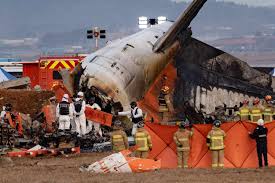
On December 30, 2024, a Jeju Air Boeing 737-800 attempted an emergency landing at Muan International Airport after a reported bird strike shortly after takeoff. During its landing attempt, the plane touched down without its landing gear, overshot the runway, crashed into a concrete embankment, and erupted into flames. Only two passengers survived.
The crash remains under formal investigation by South Korea’s Aviation and Railway Accident Investigation Board (ARAIB). However, a July 19 internal update, seen by Reuters, sheds disturbing new light on the moments leading up to the crash.
The Engine Shutdown – A Potential Fatal Error
Pilots Shut Down the Wrong Engine?
According to investigators, the left engine—which sustained less damage from the bird strike—was shut down just 19 seconds after the incident. Meanwhile, the more severely impacted right engine continued operating, albeit with flame and smoke emissions, and reportedly still generating enough power to sustain flight.
Data from cockpit voice recordings, aircraft computers, and evidence from the wreckage support the theory that pilots may have misjudged the damage and disabled the engine that could have kept them airborne.
This error eerily mirrors the 1989 Kegworth air disaster in the UK, where pilots mistakenly shut down a functional engine, leading to a fatal crash and subsequent global changes in aviation safety standards.
The Investigation So Far
ARAIB’s Cryptic Update
The July 19 update, not officially released due to concerns from victims’ families, raises more questions than answers. It notes:
-
Bird remains were found in both engines.
-
The right engine had significant internal damage and produced flames and black smoke.
-
The left engine was shut down, despite less observable damage.
Yet, investigators did not provide a detailed operational status for the left engine, nor did they clarify whether flight-critical systems tied to either engine were affected. Former US National Transportation Safety Board investigator Greg Feith, who reviewed a translation of the update, called the document “cryptic” and lacking in crucial technical clarity.
Families Demand Transparency
Grieving Loved Ones Push for Full Disclosure
Victims’ families, already devastated by the loss, are now outraged by what they perceive as premature blame being assigned to the flight crew. At a recent private briefing, family members were told the left engine also experienced a “surge”—suggesting its shutdown may not have been entirely unwarranted.
They have called on investigators to:
-
Release all supporting evidence, including black box data.
-
Investigate additional factors, such as airport design and safety standards.
-
Avoid focusing solely on pilot error while critical structural concerns remain unaddressed.
Airport Infrastructure Also Under Scrutiny
Deadly Design: The Embankment Factor
Safety experts and relatives alike have criticized the airport’s concrete embankment—a structure not designed to give way upon impact. International aviation guidelines require navigational equipment in runway zones to be installed on frangible (break-away) structures to minimize the risk of fatalities during runway overruns or crashes.
South Korea’s Ministry of Transport has since acknowledged that seven domestic airports, including Muan, have non-compliant installations. A spokesperson said the government is now developing updated infrastructure plans using safer materials, with implementation expected in stages over the next year.
Jeju Air and Industry Response
Jeju Air’s Position and Pilot Union Pushback
Jeju Air has stated it is fully cooperating with the ongoing ARAIB investigation and will wait for the final report, scheduled for release in June 2026.
Meanwhile, the Jeju Air pilots’ union has pushed back strongly against any implication that crew error was the primary cause. They argue that:
-
Bird remains were found in both engines.
-
Early leaks and selective findings could mislead the public.
-
A comprehensive analysis of crew training, aircraft systems, and emergency response procedures is necessary before conclusions are drawn.
Aircraft engine manufacturer CFM International, a joint venture between GE and France’s Safran, confirmed that post-crash inspections revealed no defects aside from damage caused by the bird strike and the crash.
The Bigger Picture – Lessons from the Crash
A Wake-Up Call for Global Aviation
This tragedy is not just a Korean issue—it’s a global warning sign. From miscommunication in the cockpit to outdated airport infrastructure and ambiguous early reports, the Jeju Air crash reveals systemic vulnerabilities in the air travel industry.
Critical takeaways include:
-
Enhanced pilot training on engine failure scenarios, especially under high-stress conditions.
-
Stronger oversight of airport designs to ensure compliance with international safety norms.
-
Transparent communication during investigations to build public trust and provide closure to grieving families.
As the final report looms, the global aviation community watches closely, hoping this tragedy will lead to life-saving reforms.
A Nation in Mourning, an Industry at a Crossroads
The Jeju Air crash was not only South Korea’s deadliest aviation disaster in recent memory—it may have been entirely preventable. Whether through pilot error, infrastructure negligence, or systemic failure, 179 lives were lost in a tragedy that demands accountability, transparency, and urgent reform.
Until the full truth is uncovered, the victims’ families continue their wait—for answers, for justice, and for a future where no one else boards a plane that never lands safely.