A National Tragedy Unfolds in Ahmedabad
In one of India’s most devastating aviation disasters, an Air India Boeing 787 Dreamliner crashed in a densely populated residential area in Ahmedabad, Gujarat, on Thursday, June 12, 2025. The flight, bound for London’s Gatwick Airport, plunged to the ground just minutes after takeoff, killing 241 of the 242 people on board.
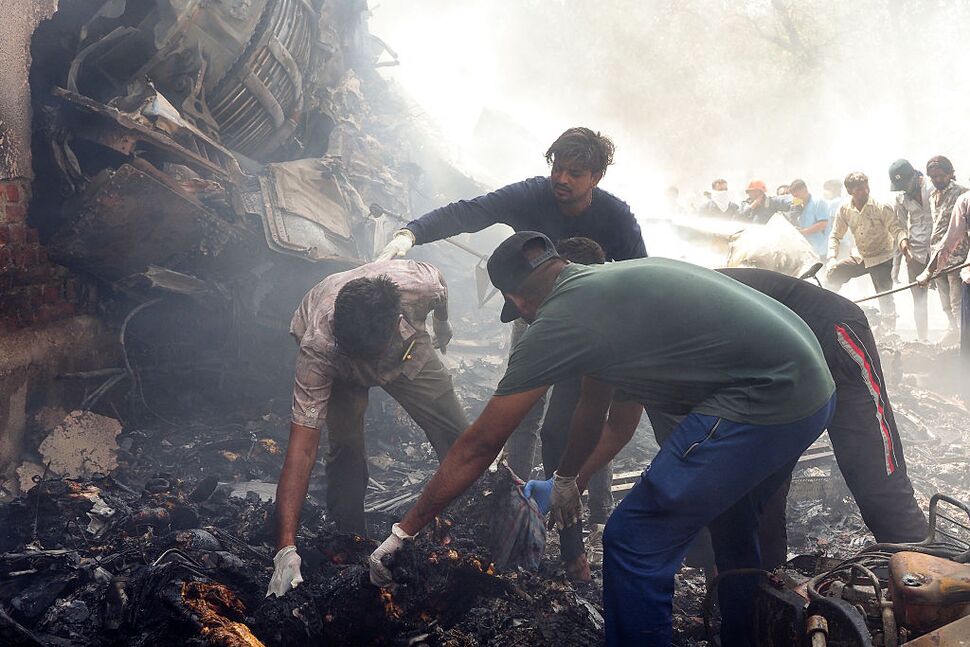
The aircraft, carrying passengers and crew, crashed into a building housing a medical college hostel, igniting a massive fire that also claimed several lives on the ground. Black smoke was seen rising above the city’s skyline as emergency responders rushed to the scene.
Prime Minister Modi Visits Crash Site and Victims
Prime Minister Narendra Modi, who hails from Gujarat, quickly visited the crash site and later met with injured victims at a local government hospital in Ahmedabad. “It is a heartbreaking tragedy,” Modi stated, promising full support to the families affected and a transparent investigation into the cause of the crash.
Modi is scheduled to chair a high-level meeting with senior aviation and disaster management officials to review the situation and ensure rapid progress in the probe.
The Sole Survivor’s Miracle Escape
Among the 242 people on board, only one passenger survived: Vishwashkumar Ramesh. His survival story is nothing short of miraculous. According to medical reports, Ramesh suffered multiple injuries and was found disoriented, but doctors confirmed that he is now out of critical danger.
“He told us the plane began descending shortly after takeoff, then split in two. He was thrown out before a massive explosion,” said a doctor who treated him at Ahmedabad Civil Hospital.
Authorities and medics are working around the clock to identify the remains of the victims. Many of the bodies were burned beyond recognition, prompting the use of DNA testing to aid in identification.
Government and Global Aviation Authorities Launch Full-Scale Investigation
Aircraft Accident Investigation Bureau Leads Probe
India’s Aircraft Accident Investigation Bureau (AAIB) has launched an immediate inquiry following international protocols set by the International Civil Aviation Organization (ICAO). Civil Aviation Minister Ram Mohan Naidu confirmed the investigation on social media and assured the public of a thorough and transparent process.
Boeing, U.S. Authorities Join Indian Investigators
In a sign of the crash’s global significance, the U.S. National Transportation Safety Board (NTSB), Federal Aviation Administration (FAA), Boeing, and General Electric have dispatched teams to assist Indian authorities. Experts from these organizations are expected to arrive in India shortly to provide technical expertise and support.
Black Box Search Underway
Authorities have yet to recover the black boxes — the flight data recorder and cockpit voice recorder — critical to understanding what went wrong. Recovery teams continue to sift through debris at the crash site, where the aircraft was completely destroyed by fire.
Aviation Safety Concerns Resurface
The crashed aircraft was a 12-year-old Boeing 787 Dreamliner, part of a fleet that has generally maintained a strong safety record. This is the first fatal crash involving the 787 Dreamliner in its 16 years of global operation.
However, Boeing as a company has been under scrutiny in recent years following a series of safety incidents involving other aircraft models, notably the 737 Max. Aviation analysts caution against premature conclusions but acknowledge that the crash raises fresh concerns about maintenance practices, operational procedures, and aircraft reliability.
The Broader Impact: Aviation, Public Safety, and Policy
Local Devastation in Ahmedabad
The impact of the crash was not limited to the passengers and crew. The plane struck a building that housed students from a medical college, killing several young students on the ground. The local community is reeling from the dual tragedy of losing both its residents and visitors.
Political and Public Pressure Mounts
The crash has ignited nationwide grief and growing public concern about aviation safety in India. There is increasing pressure on regulatory authorities and airlines to tighten safety protocols and review the operational readiness of older aircraft.
Political leaders across parties have expressed condolences, while the opposition is calling for a parliamentary inquiry into Air India’s safety standards and fleet maintenance.
Immediate Response and Long-Term Reforms
The Indian government has already mobilized emergency response teams, forensic experts, and grief counselors to assist families. The aviation ministry has promised a detailed safety audit of Air India’s fleet and operational practices following this incident.
Experts predict this disaster will lead to enhanced safety checks, regulatory tightening, and possible overhauls in aviation training and infrastructure. The final investigation report is expected to shape future aviation policies in India.