A Game-Changing Agreement Between Two Economic Giants
On Tuesday evening, President Donald Trump announced what he described as the “largest trade deal in history” between the United States and Japan—a long-awaited agreement that covers sectors from automobiles and agriculture to energy and semiconductors, with a $550 billion Japanese investment package and sweeping tariff changes.
The announcement marks a major diplomatic and economic milestone between two of the world’s largest economies and arrives amid rising global trade tensions, including ongoing standoffs with the European Union and China.
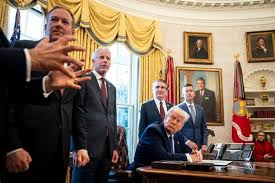
“I just signed the largest trade deal in history, maybe ever, with Japan,” Trump told Republican lawmakers during a private reception at the White House. “It’s a great deal for everybody.”
Deal Highlights: Key Elements of the U.S.–Japan Trade Agreement
1. Reciprocal 15% Tariffs on Japanese Imports
The agreement introduces a flat 15% reciprocal tariff on all Japanese exports to the U.S., replacing the previous 25% levy on automotive goods introduced in April. This change levels the playing field for Japan, giving its carmakers a strong edge over rivals from Europe and South Korea.
“Japan is the first in the world to reduce tariffs on automobiles and auto parts without volume restrictions,” said Ryosei Akazawa, Japan’s lead negotiator, speaking from Washington, D.C.
2. $550 Billion Japanese Investment in U.S. Industries
In one of the largest bilateral investment announcements in recent memory, Japan will inject $550 billion into the U.S. economy. These funds will be directed into equity and loan vehicles to support Japanese-led ventures in:
-
Semiconductors
-
Pharmaceuticals
-
Clean energy
-
Agritech
Trump added that the U.S. will “receive 90% of the profits,” though specific terms remain undisclosed.
3. Boost for U.S. Agriculture
Japan agreed to increase agricultural imports, including long-contested goods such as California-grown rice, beef, and other key crops.
“This deal opens Japan to American rice and trucks. There has never been anything like it,” Trump wrote on Truth Social.
Japanese negotiators insist their domestic farming industry won’t be harmed, citing controlled imports and quality standards.
4. Path Forward on Steel and Aluminum Tariffs
While steel and aluminum were not included in Tuesday’s deal, discussions will continue. These sectors currently remain under a 50% tariff, and any resolution will likely come in later phases of the trade dialogue.
Market Reaction: Japanese Stocks Surge on the News
The Tokyo Stock Exchange responded swiftly. On Wednesday morning:
-
The Nikkei 225 surged 3.7%, reaching a one-year high.
-
Auto manufacturers including Toyota, Honda, and Subaru posted gains of 5-9%.
-
Investors reacted positively to the removal of 25% tariffs and future clarity in U.S.–Japan economic relations.
“Mission accomplished,” declared Akazawa in a celebratory post on X (formerly Twitter), featuring a photo of him inside the White House pointing to an image of Trump with Japanese Prime Minister Shigeru Ishiba.
Strategic Implications: Jobs, Energy, and China
Trump’s Vision: Energy Cooperation in Alaska
Alongside the trade deal, Trump hinted at a new U.S.–Japan joint venture for a gas pipeline project in Alaska. Although light on specifics, Trump said both nations were “set to make that deal,” suggesting energy security is becoming a central pillar of Asia-Pacific diplomacy.
Job Creation: A Political Win for Trump
Trump claimed the agreement would “create hundreds of thousands of jobs,” especially in:
-
Manufacturing
-
Infrastructure
-
High-tech supply chains
If realized, such outcomes could become a centerpiece of the president’s economic agenda heading into the 2026 midterms.
Pressure on China: Realignment of Trade Loyalties
Japan, which counts China as its largest trading partner, has faced mounting pressure from the Trump administration to reduce ties with Beijing in favor of closer U.S. cooperation. The deal may serve as a template for trade realignment in the Pacific, influencing South Korea, Taiwan, and Southeast Asian economies.
Negotiations Were Tense but Strategic
The road to Tuesday’s agreement was anything but smooth. Trump had previously described the Japanese as “tough” negotiators, and trade talks had stalled over key issues:
-
Rice: Trump criticized Japan’s resistance to American rice, despite shortages.
-
Cars: He claimed “we didn’t give them one car in 10 years”—a statement disputed by trade data showing 16,707 U.S.-made vehicles imported into Japan in 2024.
Despite the tension, recent high-level meetings helped broker the breakthrough. U.S. Treasury Secretary Scott Bessent met with Prime Minister Ishiba in Tokyo last week and signaled that “a good deal was within reach.”
“A mutually beneficial agreement remains within the realm of possibility,” Bessent said—words that now seem prophetic.
Trade Data Snapshot: U.S.–Japan Economic Ties
-
Japan is the U.S.’s 5th-largest import source, delivering $148 billion in goods in 2024.
-
Top imports include:
-
Vehicles
-
Machinery
-
Optical and medical instruments
-
-
U.S. exports to Japan totaled $80 billion, led by:
-
Pharmaceuticals
-
Aerospace components
-
Oil and gas
-
Japan also holds $1.1 trillion in U.S. Treasury bonds, making it the largest foreign holder of U.S. debt—a fact that provided Tokyo some leverage during negotiations.
What’s Next: Follow-Up Talks and Potential Obstacles
While this deal resolves several flashpoints, it leaves room for further negotiations:
-
Steel and aluminum tariffs remain unresolved
-
Implementation mechanisms for job creation and investment oversight have not yet been disclosed
-
Regulatory alignment, especially in agriculture and biotech, may require additional bilateral dialogue
Analysts say future updates to the agreement will likely come after the U.S. trade representative’s scheduled consultations with Japanese ministers in September.
“This is a powerful signal of economic cooperation,” said Mary Lovely, senior fellow at the Peterson Institute. “But execution will matter more than headlines.”
A Big Win—But the Devil’s in the Details
The Trump–Japan trade agreement is one of the most comprehensive and consequential deals in recent U.S. foreign policy. It promises:
-
Greater access to Japanese markets for U.S. goods
-
Tariff relief for Japanese auto manufacturers
-
A massive capital injection into strategic American industries
For now, the markets are pleased, the messaging is strong, and the political optics favor Trump. But the sustainability and impact of this deal will depend on how well both governments execute on their ambitious commitments—and how competitors respond in an increasingly multipolar trade environment.