A Legacy on Heels
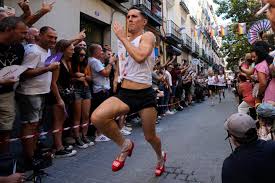
Each summer, as rainbow flags rise across Madrid’s skyline, one iconic tradition brings crowds flooding into the historic Chueca district: the Carrera de Tacones — Spain’s legendary high-heel race. On Thursday, cheers, music, and laughter filled Calle de Pelayo as dozens of participants — many in dazzling drag, all in towering stilettos — pounded the cobblestone street in a race that is equal parts celebration, protest, and pure spectacle.
It’s not just about who wins. The Carrera de Tacones is a statement of visibility, resilience, and joy — a race that began three decades ago as a rebellious act and has now become a central fixture of Madrid Pride (Orgullo), Europe’s largest LGBTQ+ celebration.
Structured Chaos – A Race With Real Rules
When Heels Are the Entry Ticket
The race may look chaotic, but make no mistake — it’s tightly organized and fiercely competitive. Every shoe is inspected to ensure it meets the 10 cm (about 4 inches) heel height minimum. No exceptions. Participants unable to meet the mark — like Edson Escolar, who flew from Guatemala to race — were gently turned away.
“It’s two centimeters too short,” a staff member explained as she measured Escolar’s blue stilettos. “I’m sorry, but you’re not going to be able to race.”
Despite his disappointment, Escolar expressed a sentiment shared by many international visitors: awe and admiration for the openness of Madrid Pride. “In Guatemala, we have Pride, but it’s nothing like this,” he told CNN. “Here, I feel so free.”
From Barroom Antics to National Stage
30 Years of Running Proud
The race began modestly in the late 1990s, founded by LL Bar — a drag bar turned Madrid institution. Back then, only a handful of spectators lined Calle de Pelayo. Today, thousands turn out. According to Chumina Power, a legendary drag queen who both performed and emceed the race:
“Pride used to be just two streets. Now, it’s the most important festival in Spain.”
Indeed, Madrid Pride attracts around 2 million visitors each year, transforming the city into a global LGBTQ+ capital.
Inside the Race – Sweat, Blood, and Glamour
Not Just a Run — It’s a Performance
Participants don’t just run. They perform. From pre-race routines (some stretching with cocktail in hand) to last-minute shoe taping and costume adjustments, each moment is full of flair.
Some veterans, like Irish-born Brian Healy, have made it an annual ritual. “I’ve competed every year since 2018 and I love it,” he said. “These shoes didn’t even have a left and right foot — but I’ve kind of got used to it!”
Others, like Pablo Lopez, were first-timers, visibly nervous but determined. “I practiced at home, but the ground is different here,” he said, wearing knee-high leather boots and a nervous smile.
The Grand Finale – Dresses, Wigs, and Brick-Filled Handbags
Just when finalists thought the race was over, organizers added a twist: a mandatory costume change mid-race. Each runner had to don a wig, throw on a long dress, and sprint to the finish line carrying a handbag full of bricks.
Despite the exhaustion — and one runner revealing a bloodied toe and torn shoe — the energy remained electric. The crowd roared as Raul Prieto, visiting from Bilbao, edged out his nearest competitor by less than a second to claim the €350 prize.
“This was so much fun,” said Prieto, grinning as he clutched his oversized check. “I want to run this race every year for the rest of time!”
Pride, Power, and Protest
A Symbol of Freedom
While the Carrera de Tacones is fun and flamboyant, it also carries weight. For many, it represents hard-won visibility in a society where LGBTQ+ rights were once taboo. As Chumina Power recalls, “Most people didn’t come to Pride to demonstrate because it was still frowned upon back then.”
Now, it’s a moment of unity — and resistance.
“It’s important to maintain the rules so we can continue this tradition for years to come,” said event manager David Bonillo, who has overseen the race since 2014.
And those rules aren’t just about heel height — they’re about safety, fairness, and honoring a tradition that has become an international beacon for LGBTQ+ culture.
From torn heels to triumphant finishes, the Carrera de Tacones remains one of Madrid Pride’s most symbolic and spectacular traditions. Beneath the sequins and stilettos lies a story of cultural evolution — from hidden protests to national pride, from drag bar antics to international headlines.
And as Spain continues to champion LGBTQ+ rights, races like this remind us that freedom often arrives in fabulous, four-inch heels.