Iran’s capital may run dry within weeks — what every leader should know
Tehran, Iran’s bustling capital of 10 million residents, is staring down a looming water catastrophe. Experts are warning that the city could hit “Day Zero” — the point at which taps run dry — within weeks, unless immediate and significant action is taken. A perfect storm of poor water management, climate extremes, and systemic governance failure has pushed the city to the brink.
President Masoud Pezeshkian, acknowledging the severity, urged urgent action:
“If we do not make urgent decisions today, we will face a situation in the future that cannot be solved.”
This isn’t just a local crisis — it’s a case study in climate vulnerability, urban fragility, and policy inaction that every CEO, policymaker, and global leader should take seriously.
The Harsh Reality of “Day Zero”
What happens when a city of 10 million runs dry?
Tehran is not new to water shortages, but this year is different. A combination of record-breaking heat and historic drought is accelerating the collapse of the city’s water infrastructure.
The Numbers Paint a Grim Picture
-
Dams feeding Tehran are at only 21% capacity, according to the Tehran Regional Water Company.
-
Rainfall has dropped more than 40% compared to historical averages.
-
Water pressure has been reduced by nearly half, impacting 80% of households.
-
In high-rise buildings, upper floors have no access to running water.
-
Aquifer overuse has caused land subsidence of over 10 inches annually in some areas.
The term “Day Zero” — popularized during Cape Town’s 2018 crisis — is now Iran’s new nightmare scenario.
A Multi-Layered Crisis with Deep Roots
It’s not just the climate — it’s mismanagement, policy failure, and poor planning
While climate change has intensified the problem, experts argue that systemic mismanagement is at the heart of the crisis.
Water Bankruptcy — Not Just a Crisis
“This is no longer just a crisis — it’s water bankruptcy,” says Dr. Kaveh Madani, Director at the United Nations University Institute for Water, Environment and Health. “Some of the damage is irreversible.”
Key causes include:
-
Decades of over-extraction of groundwater
-
Inefficient agricultural practices (which consume 90% of Iran’s water)
-
Urban expansion with no water infrastructure upgrades
-
Weak governance and policy fragmentation
According to Dr. Amir AghaKouchak of UC Irvine, “Iran’s water crisis cannot be separated from its broader governance crisis.”
How the Government is Responding
Band-aid solutions amid systemic failure
Emergency Measures Implemented
-
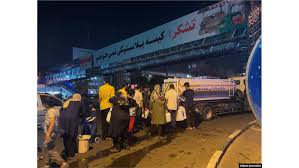
Water tankers have been deployed to neighborhoods with no access.
-
Residents who can afford it are installing personal storage tanks.
-
A one-day public holiday was declared to reduce citywide consumption.
-
Officials are considering a week-long city-wide shutdown to encourage temporary migration and relieve pressure on water systems.
But critics argue these are reactive, short-term measures that don’t address the root causes.
What’s Missing from the Response?
Experts like Madani insist that true recovery will require:
-
Economic transformation away from water-heavy agriculture
-
Desalination and wastewater recycling
-
Public-private partnerships for sustainable water infrastructure
-
Decentralized governance and transparency in water policy
But these long-term fixes are hindered by political barriers and international sanctions, which limit Iran’s access to critical technology and funding.
Climate Change as the Force Multiplier
Record heat and drought push infrastructure to the edge
Iran is enduring its fifth consecutive year of drought. Recent heat waves have pushed temperatures above 122°F (50°C) in some areas — worsening evaporation, reducing surface water availability, and increasing domestic water demand.
According to climatologist Maximiliano Herrera,
“Iran seems almost perennially in a record-heat status.”
This extreme climate reality exposes the fragility of water systems designed for a different era. The Amir Kabir Dam, once a lifeline for Tehran, now sits at dangerously low levels — a visual metaphor for a nation approaching collapse.
Economic and Social Consequences
When the taps run dry, everything stops
Water scarcity is no longer just an environmental issue — it’s a national security and economic stability threat.
Economic Risks
-
Agricultural collapse due to insufficient irrigation
-
Urban economic slowdown as water shortages shut down small businesses
-
Public health concerns due to sanitation breakdowns
-
Energy grid strain, as cooling systems and power generation are impacted
Social Unrest on the Horizon
Water shortages are already disrupting daily life, fueling public frustration and pushing people into precarious survival strategies — especially in lower-income districts, where storage tanks and water purchases are unaffordable.
A Wake-Up Call for Cities Worldwide
Tehran is today. Who’s next?
While the crisis may seem isolated, Tehran is not alone. Mega-cities across the Global South — and even parts of the developed world — are dangerously close to similar fates.
This is a playbook for what happens when population growth, poor planning, and climate change collide.
What Business Leaders Should Learn from Tehran
Water is no longer a guarantee — it’s a risk variable
For business leaders, Tehran offers critical lessons:
-
Audit your water footprint and build supply chain resilience
-
Invest in water-smart operations, especially in risk-prone regions
-
Engage in public-private partnerships to secure water infrastructure
-
Prepare for water-driven instability in global markets
Industries in agriculture, mining, manufacturing, hospitality, and logistics are especially vulnerable to water stress. Risk mitigation should be an executive priority.
Can Tehran Be Saved?
There’s still time — but barely
Tehran’s future now depends on three critical variables:
-
Immediate reduction in consumption
-
Rainfall in September
-
Rapid, systemic reform
“If Tehran survives until the end of September,” says Madani, “then there is hope for avoiding Day Zero.”
But hope is not a strategy. Tehran — and the world — needs bold, systemic change, not just tanker trucks and temporary shutdowns.