Iran-Backed Houthis Escalate Maritime War
Eternity C Attack Marks Most Lethal Strike on Shipping in Over a Year
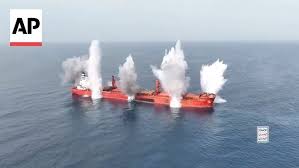
The Iran-aligned Houthi movement has unleashed a new wave of terror in the Red Sea, sinking a second commercial cargo ship in just five days and killing at least four crew members, with many more feared kidnapped or dead. The targeted vessel, the Liberian-flagged Eternity C, was attacked repeatedly between Monday and Wednesday, culminating in its total destruction off the coast of Yemen.
The deadly escalation has sparked alarm across the global shipping industry and raised oil prices amid growing fears of a renewed Houthi campaign on international sea lanes.
Houthi Strike Turns Deadly
Explosions, Kidnappings, and a Sinking Ship
The Eternity C was first attacked on Monday by Houthi sea drones and rocket-propelled grenades (RPGs) fired from fast-moving boats. Lifeboats were reportedly destroyed in the initial assault, severely limiting the crew’s options for escape. The vessel was hit again on Tuesday, forcing the remaining crew and armed guards to abandon ship as it began listing.
By early Wednesday, the ship had completely sunk.
Twenty-five people were onboard the Eternity C at the time of the attacks. While six survivors were rescued after spending more than 24 hours adrift at sea, the fate of 15 others remains unclear. Four deaths have been confirmed. The United States has accused the Houthis of kidnapping surviving crew members, calling for their immediate and unconditional release.
The ship’s crew consisted of 21 Filipinos, one Russian, and three armed security guards, including one Greek and one Indian national—one of whom was among the rescued.
Strategic and Humanitarian Fallout
US Slams ‘Kidnappings’; Greece, Saudi Arabia in Talks
The U.S. Mission in Yemen condemned the attack and alleged abduction of seafarers. “These vessels have been attacked with callous disregard for the lives of innocent civilian seafarers,” a joint statement from the International Chamber of Shipping and BIMCO said. The two leading maritime associations called for “robust support” from global powers to protect shipping in the Red Sea.
The EU’s naval mission, Aspides, confirmed its involvement in the rescue of six survivors. Greece, whose firms operated both the Eternity C and the earlier-targeted Magic Seas, is reportedly in talks with Saudi Arabia to coordinate a regional security response.
A senior official from Diaplous, the Greek maritime risk management firm coordinating the operation, vowed: “We will continue to search for the remaining crew until the last light.”
Houthi Terror at Sea: A Renewed Campaign
Solidarity With Palestinians Cited as Pretext for Attacks
The Eternity C was the second ship attacked by the Houthis in a week. On Sunday, they sank the Magic Seas, also Liberia-flagged and operated by a Greek firm. Thankfully, all crew aboard the Magic Seas were rescued.
These incidents mark a resurgence of Houthi maritime warfare tactics that previously targeted over 100 vessels from November 2023 to December 2024. The Houthis claim these strikes are acts of “solidarity with the Palestinians,” but the strategic targets—including ships with prior Israeli port connections—reveal a more complex geopolitical play.
The group released drone footage of the attack on the Eternity C, including audio allegedly from Yemeni naval forces instructing the crew to abandon ship. The footage showed explosions and fireballs engulfing the vessel, which ultimately sank beneath the waves.
Global Trade Disrupted
Red Sea Traffic Plunges, Oil Prices Surge
The Red Sea, a vital corridor for global oil and commodities trade, is now in crisis. The narrow Bab al-Mandab strait, which connects the Red Sea to the Gulf of Aden, saw daily vessel traffic drop from 43 ships on July 1 to just 30 by July 8, according to Lloyd’s List Intelligence.
The destabilization of shipping lanes has already pushed global oil prices to their highest levels since late June. Shipping insurers are once again reassessing the region’s risk classifications, and cargo firms are beginning to reroute vessels away from Red Sea waters—raising concerns over costs, insurance premiums, and delivery delays.
Policy in Shambles: A Failed Ceasefire?
May Deal With Houthis Appears Void
In May, the United States quietly struck a deal with the Houthis to halt its bombing campaign in exchange for an end to attacks on international shipping. However, the Houthis later claimed the agreement excluded Israel-linked vessels—effectively nullifying the deal’s purpose.
This raises questions about U.S. credibility and enforcement power in the region. The renewed aggression has reopened debates over whether Western powers should resume offensive military operations to deter further Houthi strikes.
The Business Risk Outlook
CEOs Urged to Reevaluate Logistics Exposure
For CEOs and boardroom strategists, the latest Red Sea developments underscore the growing risk in global shipping logistics. Firms with supply chains running through Suez are advised to:
-
Review insurance coverages and update war-risk clauses.
-
Reroute high-value cargoes via the Cape of Good Hope if feasible.
-
Engage maritime intelligence partners for real-time security updates.
-
Diversify suppliers and logistics hubs away from Middle East choke points.
Failure to act proactively could result in not just higher costs, but irreversible damage to timelines, customer confidence, and brand reputation.
What’s Next?
The sinking of Eternity C is not an isolated act of maritime terror. It is part of a broader geopolitical chess game playing out in one of the world’s most vital shipping arteries. As the Houthis escalate and U.S. policy flounders, global shippers, insurers, and investors face a volatile environment with no immediate end in sight.
While military retaliation and international diplomacy are now inevitable topics in G7 and Gulf capitals, the private sector cannot afford to wait for government solutions. Strategic resilience planning is no longer optional—it’s existential.


