Miami Commissioners Delay 2025 Elections, Sparking Outrage Over ‘Undemocratic’ Power Move
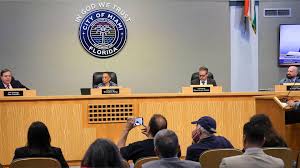
In a stunning move that’s rattling faith in local governance, Miami’s city commission has voted to extend their own terms by a full year—without seeking voter approval. The 3-2 decision, framed as a cost-saving and voter engagement strategy, has instead triggered lawsuits, state scrutiny, and accusations of a brazen power grab.
A Delayed Election, an Extended Term—And No Public Vote
With campaigns for Miami’s 2025 local elections well underway—candidates raising money, organizing volunteers, and preparing policy platforms—voters were blindsided by the city commission’s July decision to postpone municipal elections to 2026.
The change grants outgoing Mayor Francis Suarez, embroiled in scandals and facing term limits, and Commissioner Joe Carollo, also term-limited, an extra year in office. Crucially, this maneuver was enacted without a ballot initiative or public referendum.
“There’s no mechanism for this at the federal level,” said former political strategist John Jackson. “But it’s exactly the kind of anti-democratic idea that scares people.”
The city commission cited “cost efficiency” and “higher voter turnout” during federal election cycles as justification. But critics say the real intent was to cling to power.
State Backlash: “This Violates the Constitution”
Florida Attorney General James Uthmeier swiftly condemned the move in a sharply worded letter to Mayor Suarez, arguing that the decision violates the city and county charters as well as the Florida constitution.
“Miami is home to thousands of patriotic Cuban Americans who know better than most about regimes that cavalierly delay elections,” Uthmeier wrote. “The City of Miami owes to its citizens what the law requires.”
Despite legal red flags, the commission proceeded, bypassing the obvious alternative: placing the proposal on the November 2025 ballot for voters to decide.
Michael Hepburn, a candidate for mayor, criticized the logic. “We’re still having a citywide referendum this November. So voters are going to the polls anyway. What they did is just stupid—and clearly self-serving.”
A Strategic Staging Ground for Higher Ambitions?
Many observers believe Mayor Suarez may use the extra year to bolster a potential campaign for governor or Congress.
“He’s using the mayor’s office as a political springboard,” Hepburn warned. “And now, he’s got another year to do it with the full weight of his office.”
Lawsuits are underway, and state officials are being pressed to intervene. But for now, the change stands.
A Split Vote and a Divided City
The vote to delay elections split the five-member commission:
-
In Favor: Joe Carollo (R), Christine King (D), Ralph Rosado (R)
-
Opposed: Manolo Reyes (D), Damian Pardo (D)
Despite the bipartisan nature of the vote, political lines blurred. Commissioner Pardo claimed that off-cycle elections “suppress turnout” and that “moving to even years is pro-democracy.”
Yet Pardo conceded voters should ideally have had a say. “Given the situation, we had to act while we had the votes,” he said.
Critics See Hypocrisy, Power Consolidation
Eileen Higgins, a Miami-Dade county commissioner now running for mayor, slammed the decision:
“This is the chaos and dysfunction people are tired of. Instead of extending your own term, shorten the next one and let voters decide. That’s what real democracy looks like.”
The rescheduled run-off in December 2026 could be even more problematic. Higgins noted that the off-cycle timing will likely depress turnout and cost taxpayers more.
Miami Voters Are Furious—and Losing Faith
To many, this latest controversy is symptomatic of a deeper rot in Miami politics, long known for being dominated by a few politically powerful families.
“People feel it’s always the same people manipulating the system to stay in power,” said Marisol Zenteno, president of the League of Women Voters of Miami-Dade. “They’re disillusioned. They’ve stopped believing in the system.”
Some voters worry that this local precedent could inspire broader anti-democratic ideas nationally.
“If commissioners can delay elections for themselves, what stops a president from doing the same?” asked Marion Brown, who is running against Commissioner King.
The Irony: Voter Turnout Argument Undermined by Facts
Ironically, the commission’s voter engagement justification may not hold up. Yes, off-year elections attract fewer voters. Mayor Suarez’s 2021 re-election saw only about 25,000 votes cast. But Miami still plans to hold referenda this November—meaning there’s no cost savings or turnout benefit this year.
Matthew Nelsen, a University of Miami political scientist, acknowledges that on-cycle elections typically boost turnout, but emphasized process matters too.
“Voters should be the ones to approve the timing change. That didn’t happen. And now the city faces a legitimacy crisis,” he said.
Cost Savings or Constitutional Crisis?
Whether this move gets overturned in court or not, Miami’s election delay has already sent a chilling signal. It raises troubling questions about unchecked power at the local level—and whether “democracy” is becoming an optional feature of governance.
For a city that prides itself on being a beacon of freedom and civic engagement, this moment could mark a dangerous slide into political cynicism and voter apathy.


