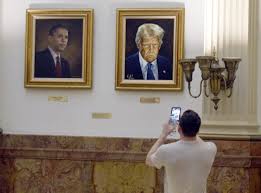
From Jowls to Jawline – The Presidential Portrait Saga in Colorado
Months after Donald Trump publicly blasted his official portrait in the Colorado State Capitol as “purposefully distorted,” a new, White House-approved version now hangs in its place—complete with a golden border designed to “catch the light and glimmer.”
This update comes after a heated back-and-forth between the former president, state officials, and Republican leaders, culminating in the removal of the original painting and a replacement deemed more in line with Trump’s personal and political brand.
“Nobody likes a bad picture or painting of themselves,” Trump said. “But the one in Colorado… was distorted to a level that even I, perhaps, have never seen before.”
The New Look – A Portrait with Power
The Artist and the Aesthetic
The updated portrait, painted by Vanessa Horabuena of Tempe, Arizona, reflects Trump’s second-term official photograph that is now featured in over 1,600 federal buildings. The image shows a more mature, glowering Trump, a stark contrast from the sunnier image from his first term, where he stood smiling in the Oval Office beside the American flag.
Commissioned with the approval of the White House, this version reportedly includes a golden frame at Trump’s request—a detail intended to convey prestige and “presidential glow.” The image closely resembles the iconography from Trump’s re-election campaign and other federal representations of his presidency.
Out With the Old – The Controversial First Portrait
Why Trump Hated It
The original oil painting, created by Colorado artist Sarah Boardman, drew sharp criticism from Trump. He claimed it made him look “jowly,” aged, and unflattering, despite its approval by the Capitol building advisory committee.
“Truly the worst,” Trump wrote, accusing the artist of having “lost her talent” after painting a “wonderful” portrait of Barack Obama years earlier.
The controversy erupted into national headlines, turning a local artistic decision into a political spectacle. The painting was commissioned through $11,000 raised by former Republican state Senate president Kevin Grantham and had been part of a broader initiative to include all U.S. presidents in the Capitol’s portrait hall.
Fallout and Political Reactions
When Republican leaders in the state requested the painting’s removal following Trump’s remarks, Colorado House Democrats issued a brief but pointed statement:
“If the GOP wants to spend time and money on which portrait of Trump hangs in the Capitol, then that’s up to them.”
Boardman, standing by her work, explained her intent was to keep the portrait “neutral” and historically balanced. She emphasized that the image was meant to be a thoughtful depiction, rather than either celebratory or critical.
“In 10 or 20 years, he will just be another president on the wall. He needs to look neutral,” she said.
The Broader Symbolism – Vanity, Legacy, and Optics
This portrait controversy is more than just an artistic squabble—it underscores Trump’s obsession with personal image and historical legacy. From his carefully curated portraits in the White House to removing Barack Obama’s official painting from the grand foyer, Trump has made visual representation a key aspect of his presidency.
Another image of Trump, this time with his fist raised after surviving an assassination attempt at a rally in Pennsylvania, has taken up the former location of Obama’s portrait, further entrenching his narrative of strength and defiance.
A Tale of Two Portraits – Trump’s Dual Image
What’s striking is the contrast in how Trump is depicted across different official representations:
-
The first-term portrait: Smiling, approachable, standing proudly in the Oval Office.
-
The new Colorado portrait: Older, more serious, glimmering with authority.
-
The Truth Social image: Fist in the air, captured post-assassination attempt—used as a symbol of resilience.
Each image, while different, plays a role in shaping Trump’s public mythology, one that he clearly takes into his own hands when needed.
Image is Everything – Especially for Trump
The removal and replacement of Trump’s Colorado portrait is more than just an exercise in aesthetics—it’s a symbolic power move. It’s about narrative control, brand consistency, and asserting dominance in spaces where even brushstrokes are political.
As Trump continues to shape his second term, from policy decisions to personal optics, expect more efforts like this—where legacy is crafted not just in laws, but in frames, colors, and the expressions frozen in oil on canvas.